Why Vein Tests Don't Always Work

One of the most common undertone "tests" you'll find online is the vein test:
Blue or purple veins = cool undertone
Green veins = warm undertone
Blue-green veins = neutral undertone
It sounds simple, but there is very little scientific evidence that vein colour can accurately determine a person's undertone.
In reality, vein colour is influenced by a number of biological and optical factors that have little to do with your seasonal colouring. This is why many people perform the vein test and walk away more confused than before.

Veins Aren't Actually Blue or Green
This surprises many people, but veins are not blue or green.
The blood inside your veins is red.
Even deoxygenated blood—which is returning to the heart through the veins—is still a dark red or maroon colour, not blue.
So if the blood is red, why do veins often appear blue, purple, or green through the skin?
The answer lies in how light interacts with your skin and underlying tissues.

How Light Changes What We See
When light hits the skin, some wavelengths are absorbed while others are reflected back to our eyes.
Skin scatters and absorbs light differently at different depths. Red wavelengths tend to penetrate deeper into the skin, while shorter wavelengths are scattered closer to the surface.
As light passes through the skin and reflects off underlying structures, our brains interpret these wavelengths in a way that can make veins appear blue or purple, even though the blood inside them remains red.
This is an optical phenomenon rather than a direct reflection of the blood's actual colour.
Why Veins Look Different in Different Parts of the Body
If vein colour truly determined undertone, all of your veins would appear the same.
Yet most people notice that this isn't the case.
For example:
Wrist veins may appear blue.
Hand veins may appear green.
Arm veins may appear blue-green.
Foot veins may appear purple.
This happens because different parts of the body have:
Different skin thickness
Different amounts of fat beneath the skin
Different blood vessel depths
Different levels of pigmentation
Different levels of sun exposure
Veins that sit closer to the surface often appear differently from veins located deeper beneath the skin.

Surface Pigmentation Can Change How Veins Appear
Another reason vein tests can be misleading is that you're not just seeing the vein itself—you're seeing the vein through a layer of skin that contains its own pigments.
The colour of your skin acts like a filter.
For example:
Yellow or golden surface pigmentation can make veins appear greener.
Pink or rosy surface pigmentation can make veins appear more purple.
Very fair or translucent skin often makes veins appear bluer.
Olive skin can create a green appearance because yellow-green pigments influence how the underlying vein is perceived.
Darker skin tones may make veins appear deeper blue, purple, or less visible due to increased melanin content.
Think of it like looking through coloured glass. The object underneath remains the same, but the colour you perceive changes depending on the filter in front of it.
This is why someone can have:
Green-looking veins on their hands
Blue veins on their wrists
Purple veins on their feet
all at the same time.
The veins themselves haven't changed colour. What has changed is the way the skin, pigmentation, and lighting interact with the light reaching your eyes.

Lighting Changes Everything
Lighting can dramatically alter what you see.
Under:
Warm indoor lighting
Cool daylight
Fluorescent lighting
Shadow
Direct sunlight
the exact same vein may appear completely different.
Many people have experienced looking at their veins in one room and seeing blue, then moving into another room and seeing green.
This is another reason vein colour is not considered a reliable indicator of undertone.
Overtone and Undertone Are Not the Same Thing
One of the biggest misconceptions surrounding vein tests is that they assume visible surface colouring and undertone are the same thing.
They are not.
Overtone refers to the colour we can visibly see on the surface of the skin.
Undertone refers to the deeper colour harmony revealed through colour interaction.
For example, someone may have:
Yellow-looking skin and a cool undertone
Pink-looking skin and a warm undertone
Olive skin and either a warm or cool undertone
Because veins are viewed through surface pigmentation, they often tell us more about overtone than undertone.
What Science Tells Us
From a scientific perspective, vein colour is largely influenced by:
Optical light scattering
Skin transparency
Skin thickness
Blood vessel depth
Surface pigmentation
Melanin levels
Lighting conditions
None of these factors directly measure the colour dimensions used in professional colour analysis.
This means two people with identical undertones may have completely different-looking veins, while two people with very different undertones may have veins that appear exactly the same.
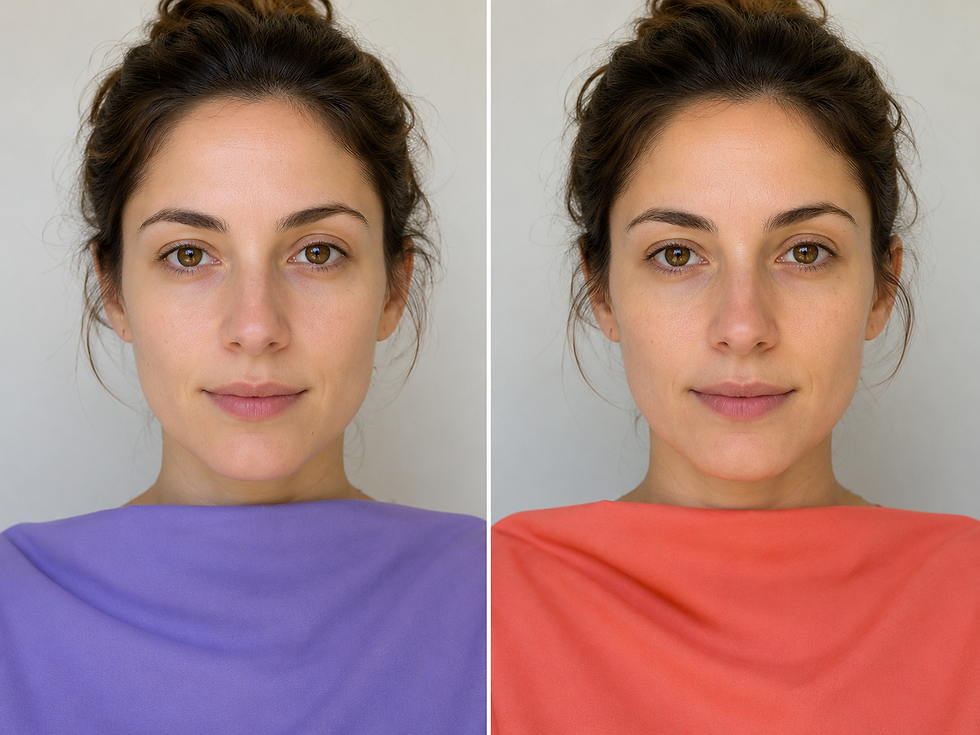
How Colour Analysis Determines Undertone
Professional colour analysis does not determine undertone by looking at veins.
Instead, we observe how colours interact with the face.
Through draping and colour comparison, we assess how different colours affect:
Skin clarity
Feature definition
Brightness
Shadows
Redness
Sallowness
Overall harmony
The correct colours create balance and harmony.
The incorrect colours create visual disharmony, drawing attention away from the person and towards the colour itself.
These reactions provide far more reliable information than vein appearance alone.
The Bottom Line
Veins appear blue, purple, or green because of optics, anatomy, skin pigmentation, and lighting—not because the blood itself is blue or because your undertone is warm or cool.
The same person can have veins that appear different colours across different areas of their body, and the same vein can look different depending on the lighting.
While vein colour may provide an interesting observation, it is not a scientifically reliable method for determining undertone.
If you've ever looked at your veins and felt confused, you're not alone. That's because your veins are telling a story about light, skin, and anatomy—not necessarily about your season.

Want to Discover Your True Undertone?
A professional colour analysis evaluates how colours interact with your skin rather than relying on simplified tests like veins, jewellery, or eye colour.
I offer in-person colour analysis in Melbourne and virtual analysis worldwide to help you discover your undertone, season, and most harmonious colours.
The Colour Mentor


Comments